OUR HISTORY
1880s – Our Chinese-Hawaiian Beginnings
The Five Flowers of China
by Aulii Mitchell, the son of Harriet Aana Cash Mitchell
On the island of Hawaiʻi in a village near Hilo, Neheupalani, a direct descendant of Keawehiku, a high chiefess from the district of Waimea, married Kuamoana. They gave birth to a son and named him Kahaoleʻōpūnui, meaning the foreigner with the big stomach. Kahaoleʻōpūnui married Kamaka and they gave birth to a girl. They named their daughter Kahaoleʻauʻa, meaning the foreigner who does not give or who holds back. We can only wonder why the family repeated the use of the word haole (foreigner) in their names for there was no evidence that they had any foreign blood (Kai 1976:3).
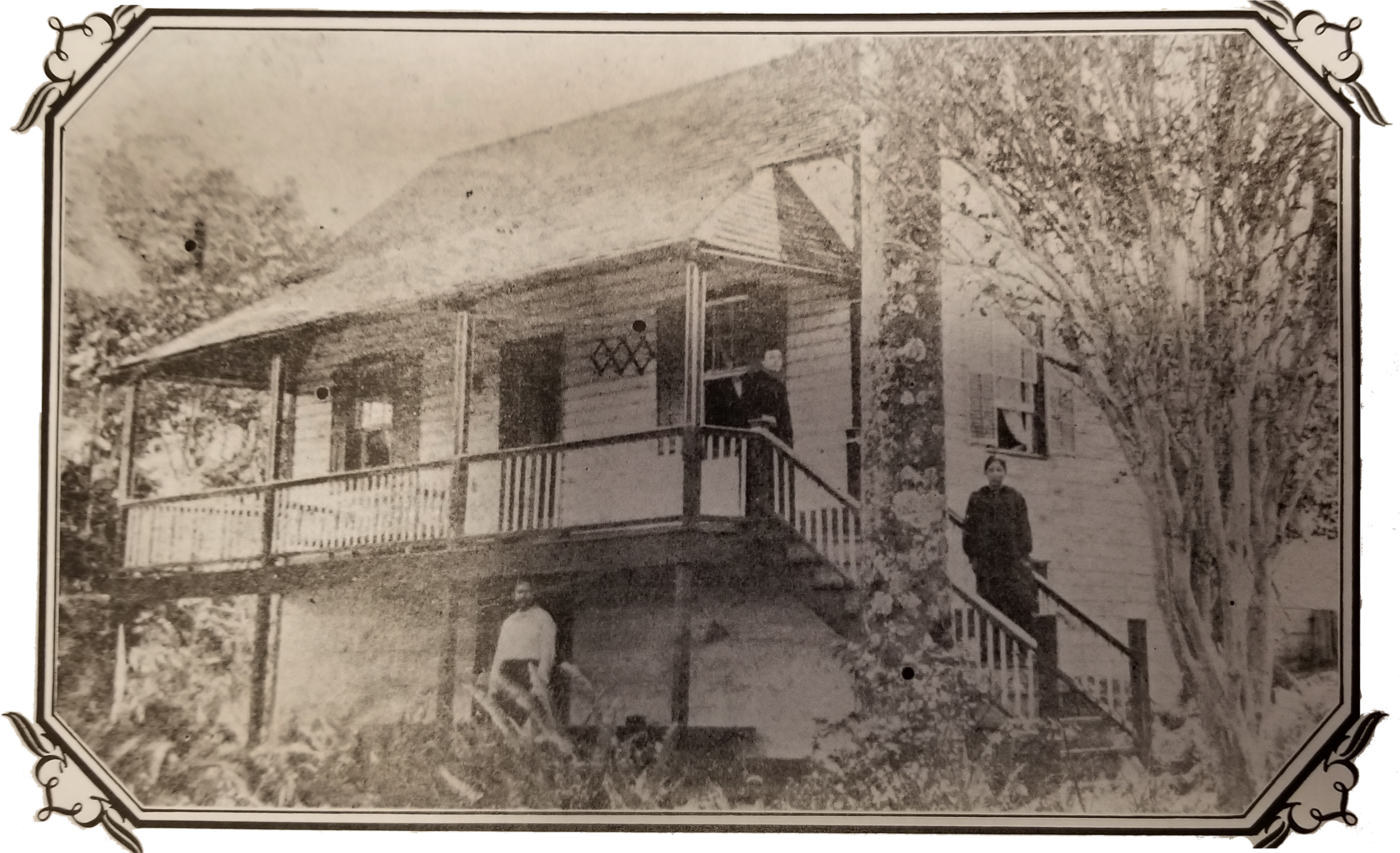
There in the lands of Kūkūau in the district of Hilo lived Kahaoleʻōpūnui and his wife Kamaka. Both Kahaoleʻōpūnui and his father served as konohiki or land agent for John Young I, called Olohana, and John Young II called Keoni Ana Ministers of the Interior for Kamehameha III. Although the whole ahupuaʻa of Kūkūau 1 had been given to John Young I by Kamehameha I as a reward for valuable assistance in one of Kamehamehaʻs battles, customary in Hawaiian culture, Kahaoleʻōpūnuiʻs family was considered to have rights to a part of it under the Great Māhele land tenure system. When the Hawaiian land system was conformed to Western land ownership, Kahaoleʻōpūnuiʻs land was granted to him, Land Commission Award No. 3206 (Kai 1976:5*).
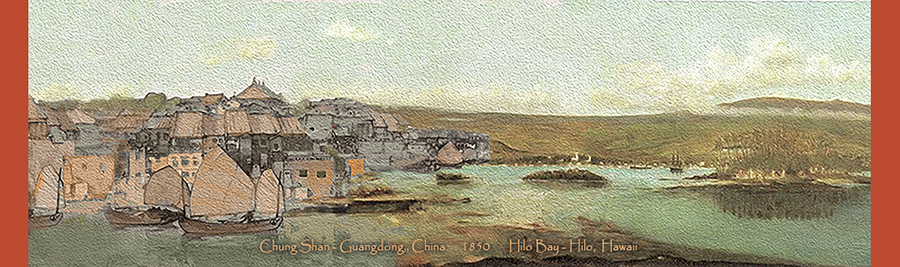
Enter Tong Yee Aʻii, a Chinese man from South China. He grew up in the village of Tong Ka in Zhongshan County, Guangdong Province. This was on the shores of the estuary of the Pearl River (the Chu Kiang) between Canton and Macao. In 1849 he followed the trail of gold to California. The next year (1850) Tong Yee Aʻii arrived by ship to the shores of Hilo on the island of Hawaiʻi. Hilo was still very much Hawaiian in language customs, and population. Tong Yee Aʻii joined a small group of Chinese men who had married Hawaiian women and became citizens of the Hawaiian Kingdom. Most of them were operating primitive sugar mills converting cane into sugar (Kai 1976:1*).
In 1851 Tong Yee Aʻii married a beautiful sixteen-year-old Hawaiian girl, Kahaoleʻauʻa, the daughter of the chief Kahaoleʻōpūnui. As years went by Tong Yee Aʻii and Kahaoleʻauʻa would give birth to five daughters, all given melodious names that reflected their unique heritage, half-Hawaiian and half-Chinese, nā pua o Kina, meaning the flowers of China. Aana Hattie Aʻii, Aima Emma Aʻii, Aʻlai Jessie Aʻii, Aʻoe Lizzie Aʻii, and Mihana. All direct descendants of the high chiefess Keawehiku (Kai 1976:3*).
Soon after the birth of Mihana, perhaps because he had no son to carry on the Tong family lineage, Tong Yee A’ii left his Hawaiian family, returning to his native village of Tong Ka in Zhongshan, Guangdong, China. There, he bore three children with his first wife, Choy Seh. Eventually, Tong Yee A’ii traveled back to Honolulu, living there until his death in 1861. Seven years Tong Yee A’ii’s death, his only son, Tong Chong (aka Jack), sailed from his home in China to the Hawaiian Islands, where he founded a rice mill, the Sing Chong Co. in Honolulu. Sadly, the five daughters of Hilo and their half-brother Jack never met. Although it appears that the early Hawaiian and Chinese descendants were aware of both families’ existence, over time the memory of the kinship was, unfortunately, lost.
It was not until 148 years after the 1851 union of Tong A’ii and Kahaole’au’a, that their Hawaiian and Chinese descendants found each other again, and, for the first time, came together united as one ‘Ohana, at the 1998 Tong family reunion in Honolulu.
**Kai, Peggy, The story of A’lai Aii: our Hawaiian-Chinese heritage. c1976.
1998
How I Discovered our Living Hawaiian Relatives
by Wyleon Lo, grandson of Tong Phong – March 1997
First, I have to thank Jo-Lynne Lee, whose librarian friend on the island of Hawaii gave her “The Story of A’lai.”* This book is a clear, loving account of great-great grandfather Tong Yee’s Chinese-Hawaiian descendants, a branch we had lost touch with over the generations.
Looking through this book, I was shocked to learn our connection with Ernest Kai, a famous Honolulu politician of the 1950’s. I became curious to compare the flow of venerations from great-great- grandfather Tong Yee’s two families. At that time I had no genealogy chart for their branch to compare with us, so I made a simple one. I found that Ernest, my mother Tong Kam Ha and my uncles Tin Yen and Tin Wai were all fourth generation from Tong Yee.
Somehow this made all our branches seem very close and I decided to actually try contacting Ernest’s family. However, when I began by looking in the telephone directory, I found 47 Kai’s listed and none matched names given in the book. Then I remembered that Ernest and retired U.S. Senator Hiram Fong had been political colleagues. But when I called the Senator, I could only learn that Ernest had just one daughter who lived somewhere on Nuuanu Ave. and no further details.
Unable to continue the search for the Kai family, I decided to try other names in the [Story of A’lai”] book. “Baker” was another possibility, but there were over 100 listings in the phone directory. “Aluli” had only 10 listing and 3 matched those in the book: Kep (short for Kepoikai), Irmgard, and Yuklin. I first tried calling Kep, who is also from the fourth generation and one of Emma Yuklin Akamu and Noa Webster Aluli’s six children. I could only get a “This number is no longer in service” recording. Next I tried calling Yuklin Aluli, assuming she was Emma Yuklin Akamu’s granddaughter. I left messages with her law office but received no response. Then I called the number for Irmgard Aluli, composer of the songs included in the book. The other end of the line answered all my questions with a sweet, friendly voice. It really was Irmgard, widow of Auwae Leong Nane Aluli. She old me her brother-in-law Kep had at one time gone to China and located the family of A’Lai’s only son, Aloehu Akamu, in the village of Chung San. But Kep’s health is failing now, keeping him home. For more information Irmgard gave me the number foe Kep’s youngest sister Emma Akana Meyer. Kep and Emma are the only two living of Emma Yuklin Akamu and Noah Webster Aluli’s six children.
Irmgard also told me that Emma is very busy with religious work and it would be best to call her after six o’clock. When I finally reached Emma, her voice was so warm and friendly it seemed we had already known each other for ages. We arranged to have lunch, by brother Waituck included, the following week in Chinatown, Thursday, January 30, 1997.
On the day of the luncheon, Waituck and I were so excited we waited at the wrong restaurant for half an hour. When we realized the building actually had more than one restaurant, we ran for the right one. As we were anxiously looking around the front of the restaurant, Emma and the daughter who had accompanied her must have recognized us from my pre-arranged description: “Two half bald men with one carrying a white shopping bag.” Emma and her beautiful daughter** dashed out and immediately hugged us. We were all truly like long lost friends finding each at last. After 147 years great-great-grandfather Tong Yee’s two families were reunited. At that moment, I felt electricity going through my whole body. I could never in my life have imagined how happy I would be to discover unknown relatives. “Aunty” Emma looked like a typical Chinese lady. Her daughter, A Stanford art graduate, showed her mixed heritage strongly.
After introductions, Waituck and I began telling them what we knew about our family history. Great-great grandfather Tong Yee arrived in Hilo, Hawaii, in 1850. Although he already had a family in China, he married a young Hawaiian chieftess. After this marriage produced five daughters, he returned along to China in 1860. Unknown to his Hawaiian family, he came back to the island and died in Honolulu in 1862. He remains and part of his wealth were sent to his Chinese family in Tong Kah. This allowed his only son Tong Chong to come to Honolulu in 1868. After a stint at farming, Tong Chong started a rice mill, Sing Chong, at 1917 Maunakea Street. Later, he was able to bring over his older son, Tong Phong, (one of his six children) to Honolulu. Tong Phone attended Iolani, St. Louis and Columbia. After graduating, Tong Phong returned to Honolulu and started the First Chinese American Bank. The bank operated temporarily in the Sing Chong location, then moved a few months later to a new structure on the corner of King and Nuuanu. The modern, up-to-date interior of this banking house compared favorably with any in the city.
Although there were so many more things to talk about, our reunion with Emma could not be as long as we wished. Both Emma and her daughter had to leave for other commitments. We are hoping to get together again.*** Perhaps Kep, who is recovering from a stroke last year, will be able to join us.
___________________________________
*Kai, Peggy, The story of A’lai Aii: our Hawaiian-Chinese heritage. c1976.
**Emma’s daughter is Meleanna Aluli Meyer.
***The first Tong Family Reunion in Honolulu was in 1998, where many descendants of Tong Yee’s Hawaiian and Chinese families gathered for the first time in 148 years. The latest gathering was held July 26-30, 2019, in Honolulu with an extension tour of ancestral sites in the Hilo area.
A record number of approximately 90 people attended one or more events.